Education: Addressing a Missing Link
Dixon and Newlon (2010) noted that there needs to be a broader understanding of informatics as nurse educators were unclear of what informatics is as well as what competencies students will need for the future. They noted three literacies required for nursing informatics: computer literacy, information literacy, and informatics literacy (Dixon & Newlon, 2010). Interestingly, among the study participants, informatics literacy was not identified as a requirement, which indicates a research to practice gap. As the majority of nurse educators are not comfortable with nursing informatics, they avoid informatics in the curriculum (Pilarski, 2011). Miehl (2012) noted that although there were benefits to virtual reality and electronic health record (EHR) training, instructors still reverted back to textbook and classroom learning; their perceived comfort zone. Pilarski (2011) noted that a nursing informatics specialist added to the faculty can bridge the gap. The nursing informatics specialist role is essential in ensuring nursing informatics is incorporated into the curriculum. The role of the nurse informatics specialist in the education arena is similar to their role in other healthcare settings.
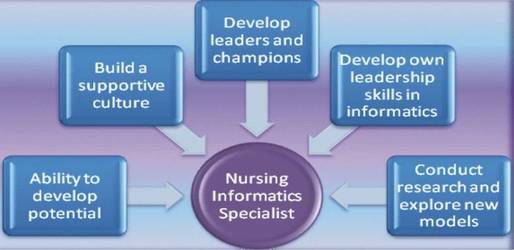
Adapted from Troseth, 2012
Educating Nursing Informatics Specialists
The future of nursing informatics is an ever changing, ever expanding field. Demand for informatics nurses is exceeding the supply (Sensmeier, 2010). There is an increasing need for informatics nurses as well as nursing informatics specialists. Kwantlen Polytechnic University (2011) noted that informatics education is an independent, self directed pursuit.
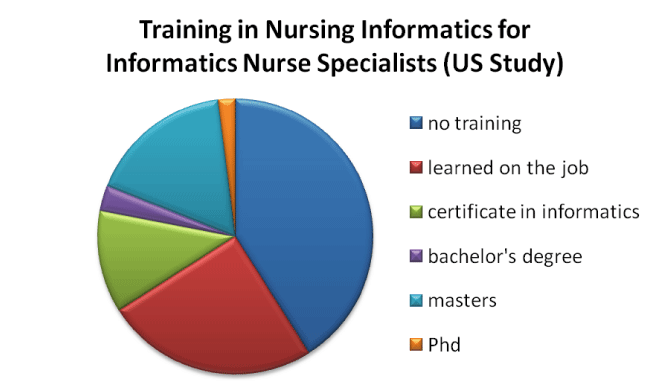
Adapted from: Healthcare Information and Management Systems Society (2007)
Options for education
Options for education
Formal educational programs baccalaureate and graduate level
Conferences, workshops & professional development
Distance learning & self-study
On-the-job training

According to Cowey, Fenton, and Kushniruk's survey (2011), you can obtain a bachelor's degree, masters or PhD in Health Informatics at several institutions in Canada, but the University of Victoria offers the only Bachelor's degree in Nursing and Science in Health Informatics. The need to have more clinical practice incorporated into information technology and information management has heightened awareness to the informatics field and more opportunities to become educated are becoming available. Identifying core competencies needs to be the first step in overcoming the nursing informatics deficit in today's curriculum (Dixon & Newlon, 2010).
COACH has developed core competencies which represent the minimum requirements necessary for a Health Informatics professional to practice. As a Health Informatics professional continues to specialize, advanced competencies may be required.
COACH Core Competencies for Health Informatics Professionals
There are 7 core competencies that fall within three disciplines.
Information Sciences - information technology and information management competencies
Management Technologies - analysis and evaluation, organizational and behavioural management, and project management
Health Sciences - clinical health services and the Canadian health system
(Canadian’s Health Information Association,2009).
Most recently the Canadian Association of Schools of Nursing (CASN) developed national core competencies for graduate nurses. This was nationally endorsed April 2012
The 3 entry-to-practice nursing informatics competencies include:
Health Informatics Training (HITS) is available as an electronic, self-learning tool for health care users. The program provides basic learning concepts and terminology in the use of computers in healthcare. The training is endorsed by the Canadian Nurses Association (CNA) and consists of 8 modules:
Computer hardware and software in health care networks and health informatics
Networks and health informatics
Understanding data, information, and knowledge
Protecting information: security, privacy and confidentiality
Electronic record keeping in health care
Administrative systems
Clinical information systems
Decision support systems
(Canadian’s Health Informatics Association, 2012)
The Canadian Nursing Informatics Association (CNIA) allows access to journal articles as well as member blogs regarding up-to-date information on nursing informatics. Membership in CNIA will open up links to further education opportunities.
Please view the following link for other educational institutions which offer Health Informatics education.
Current Nursing Informatics Educational Opportunities in Canada, USA and International
COACH has developed core competencies which represent the minimum requirements necessary for a Health Informatics professional to practice. As a Health Informatics professional continues to specialize, advanced competencies may be required.
COACH Core Competencies for Health Informatics Professionals
- 2005-2006 through a series of consultations and meetings, COACH’s health informatics professionalism steering committee defined health informatics and developed a set of core competencies for health informatics.
- 2007 the competencies were released
- 2008 Using feedback from the initial release of the competencies minor revisions were made.
- 2009 release of updated competencies, addition of a career matrix and new introductory sections.
There are 7 core competencies that fall within three disciplines.
Information Sciences - information technology and information management competencies
Management Technologies - analysis and evaluation, organizational and behavioural management, and project management
Health Sciences - clinical health services and the Canadian health system
(Canadian’s Health Information Association,2009).
Most recently the Canadian Association of Schools of Nursing (CASN) developed national core competencies for graduate nurses. This was nationally endorsed April 2012
The 3 entry-to-practice nursing informatics competencies include:
- Information and Knowledge management
- Professional and regulatory accountability
- Use of Information and Communication Technologies (ICT)
Health Informatics Training (HITS) is available as an electronic, self-learning tool for health care users. The program provides basic learning concepts and terminology in the use of computers in healthcare. The training is endorsed by the Canadian Nurses Association (CNA) and consists of 8 modules:
Computer hardware and software in health care networks and health informatics
Networks and health informatics
Understanding data, information, and knowledge
Protecting information: security, privacy and confidentiality
Electronic record keeping in health care
Administrative systems
Clinical information systems
Decision support systems
(Canadian’s Health Informatics Association, 2012)
The Canadian Nursing Informatics Association (CNIA) allows access to journal articles as well as member blogs regarding up-to-date information on nursing informatics. Membership in CNIA will open up links to further education opportunities.
Please view the following link for other educational institutions which offer Health Informatics education.
Current Nursing Informatics Educational Opportunities in Canada, USA and International
Helping to Educate Future Nurses:
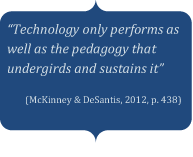
According to a survey by Jette, Tribble, Gagnon, and Mathieu (2010), only 14% of nursing students have been trained on computerized nursing information systems and fewer have been trained on hospital information systems. Nursing programs have always placed an emphasis on hands on training via practicum placements, but they are lacking in hands on training for nursing informatics.
Benefits from increased focus on nursing informatics:
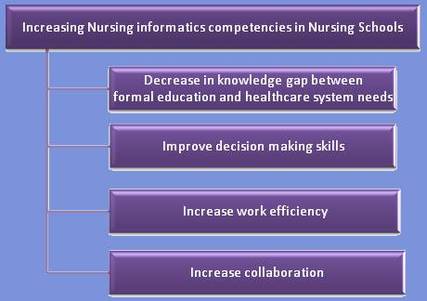
Adapted from: Pilarski, 2011
The following is a video created by Conestoga College to describe the experiences these students have studying in the Health Informatics Management field.
The following is a video created by Conestoga College to describe the experiences these students have studying in the Health Informatics Management field.
(Conestoga College, 2010)
